
 MEMBER CENTER

The PowerPoints and brochures looked slick. The carefully managed hedge fund was audited by the notoriously meticulous accounting firm KPMG, with the support of global banking juggernaut Deutsche Bank.[1] Helmed by Fox News commentator George R. Jarkesy, Jr., the investment opportunity with Patriot28, LLC seemed golden. After all, the investments were backed by low-risk life insurance policies.[2] Unfortunately for investors, almost none of the claims in Patriot28’s marketing materials turned out to be true.[3] And when the Securities and Exchange Commission (SEC) brought penalties against Jarkesy, Jr. and his company, they didn’t even contest the wrongdoing.[4] Nevertheless, Jarkesy, Jr. didn’t find the penalty fair—and he wanted to fight. The resulting lawsuit contested not the merits of the action against him, but the fairness of the hearing he received. While securities fraud may appear wholly removed from environmental law, the resulting case, SEC v. Jarkesy, will have a seismic effect on the Environmental Protection Agency’s ability to enforce its own congressional mandates.
I. The EPA and its Role in the Administrative State
As a federal agency, the EPA is a part of the administrative state. Established by Richard Nixon in 1974, the agency’s stated mission is to ensure that Americans have clean air, land, and water.[5] The agency accomplishes this through enforcement of environmental regulations passed by Congress.[6] Some of the most popular laws enforced by the EPA are the Clean Air Act (CAA), Clean Water Act (CWA) and the Resource Conservation and Recovery Act (RCRA). These laws have had a major impact on the environment in the United States and have preserved or improved the quality of life for millions of Americans.
As an agency of the United States government, three recent watershed administrative law decisions should be viewed as potentially having a major impact on environmental law due to their bearing on the EPA.
II. A Closer Look at Jarkesy
In SEC v. Jarkesy, 603 U.S. 109 (2024), the Court considered SEC panels with the ability to mete out cash civil penalties against those found guilty of white-collar crime. The petitioner, George R. Jarkesy, Jr. had received a $300,000 penalty for SEC violations from an administrative law judge (ALJ) for defrauding investors.[7] He argued that trying the case in front of an ALJ violated his Seventh Amendment right to a jury trial. The Court took up this “straightforward” issue in Jarkesy—“whether the Seventh Amendment entitles a defendant to a jury trial when the SEC seeks civil penalties against him for securities fraud.”[8] Under the Seventh Amendment, citizens have a right to a jury trial in civil cases for controversies involving over $20.[9] Some agencies, including the SEC, use ALJs to adjudicate enforcement actions.[10]
The SEC was empowered by the Dodd-Frank Act to help keep financial markets fair and healthy after the Great Recession.[11] Proponents of ALJs point to the development of expertise in their respective regulatory fields and the fact that ALJs can hear matters quickly compared to the traditional legal system.[12] They are also known for “transparency and reasoned decision-making, as well as uniformity, predictability and greater political accountability.”[13] The downside is that they are sometimes seen as “servants of the same master” as regulators, thus more likely to support agency penalties.[14] Administrative trials also have different procedural and evidentiary rules, e.g., hearsay is permitted in administrative trials.[15] Whatever the reason, George Jarkesy, Jr. thought he would have better chances in front of a traditional jury than an ALJ.
The Court first considered whether George Jarkesy, Jr.’s claim was “legal in nature”[16] (as opposed to equitable in nature). To make the determination, the Court looked to the remedy available, civil penalties. The SEC’s penalties against the defendant were “to vindicate a public interest in the securities market,”[17] rather than to restore the victims of Jarkesy, Jr.’s alleged fraud. The majority reasoned that because the penalties focused on “culpability, deterrence, and recidivism,” and not compensating victims, “such considerations are legal rather than equitable.”[18] For this reason, the nature of the claim implicated the Seventh Amendment.[19]
Yet even when the Seventh Amendment provides for the right of the accused to a jury trial, a “public rights” exception applies to some claims. “Under this exception, Congress may assign the matter for the decision to an agency without a jury,” the Chief Justice Roberts explained in Jarkesy.[20] Private rights are “made of ‘the stuff of the traditional actions at common law tried by the courts at Westminster in 1789’” and require adjudication by an Article III court.[21] The majority compared SEC securities fraud to common law fraud claims, finding the claims share “an enduring link,”[22] despite the fact that modern securities markets would be unrecognizable to anyone in Westminster, England in 1789.[23]
On the other hand, public rights, which are subject to exception from the jury requirement, include the government’s ability to collect revenue on behalf of the Treasury,[24] to penalize a steamship line for bringing unhealthy immigrants to U.S. shores,[25] and to allow the President to set tariffs,[26] among others. The majority admits that “our opinions governing the public rights exception have not always spoken in precise terms,”[27] but insists that there is a presumption that Article III courts should hear most matters.[28] Conversely, the dissent found no confusion in distinguishing public and private rights. “The doctrine’s heartland consists of claims belonging to the government,” Justice Sotomayor wrote. As such, Congress may “empower federal agencies to adjudicate such violations and impose the appropriate penalty.”[29]
Two particular cases loom large in the Court’s reasoning: Granfinanciera v. Nordberg, 492 U.S. 33 (1989) and Atlas Roofing v. OSHRC, 430 U.S. 442 (1977). “Granfinanciera effectively decides this case,” the majority held.[30] A bankruptcy case involving a fraudulent conveyance, Granfinanciera considered whether a debtor could contest action taken by a trustee by putting the question to a jury.[31] The bankruptcy trustee had statutory support on its side.[32] While Congress had granted bankruptcy judges authority over “core bankruptcy proceedings,” including fraudulent conveyances,[33] such delegation of authority “was not dispositive.”[34] Instead, the Court looked to common law and found that fraudulent transfer was a common cause of action in 18th century England, thus implicating the right to a jury trial under the Seventh Amendment. Further, fraudulent conveyance was not “closely intertwined” with the bankruptcy process because the actions could be brought as standalone claims.[35] The Court concluded that despite the Congressional authority of bankruptcy trustees and judges, it was not enough to displace the right to a jury trial.[36]
By contrast, the Dissent relies heavily on Atlas Roofing v. OSHRC.[37] This case involved two companies penalized by enforcement of the newly passed Occupational Safety and Health Act (OSHA).[38] Both companies had violated the act, resulting in the death of a worker.[39] They were hit with penalties of $7,500 and $600, respectively, and requested a hearing to contest their fines. Despite the fact that ALJs reduced their penalties upon appeal, the companies demanded a jury trial under the Seventh Amendment of the Constitution.[40] The Atlas court unanimously held that Congressional authority allowed ALJs to enforce OSHA through administrative proceedings. Interestingly, although the Court declined to apply the Atlas holding to Jarkesy, Chief Justice Roberts stated explicitly that Jarkesy does not overrule Atlas.[41] .
Both the majority and the dissent cited Tull v. United States, 481 U.S. 412 (1987), a case that speaks directly to the authority of the Environmental Protection Agency. In Tull, the EPA pursued civil penalties against a developer for violations of the Clean Water Act (CWA) by bringing a lawsuit against them in federal district court.[42] The case was heard by a bench trial, but the accused requested a jury trial under the Seventh Amendment.[43] After an analysis that the cause of action was similar to “suits at common law,” the Supreme Court reversed the lower courts, holding that the case implicated the right to be heard by a jury. While the majority relied on Tull by analogizing SEC and EPA violations as close cousins of similar suits at common law, Justice Sotomayor pointed out a major difference: the case against the defendant in Tull was brought in federal court to begin with, not heard by an ALJ as in Atlas.[44] Notwithstanding this distinction, Tull was cited in support of a jury trial for George Jarkesy, Jr.
The Jarkesy ruling expanded the rights for those accused by the SEC, giving them access to jury trials. It also limited the administrative state’s power to enforce regulations protecting consumers against fraud and could make it harder to hold bad actors accountable for white-collar crime, an area of criminal activity that already goes underprosecuted.[45]
III. What’s Next for the EPA after Jarkesy?
While the full impact of Jarkesy remains to be seen, it will likely result in substantial changes to EPA prosecution. In 2022, over half of the 1,540 enforcement actions taken were simple penalty orders imposed by EPA workers.[46] As shown below, since 1997, over 90% of all contested enforcement was adjudicated using an ALJ, with the percentage of judicial enforcements in the single digits each year.[47]
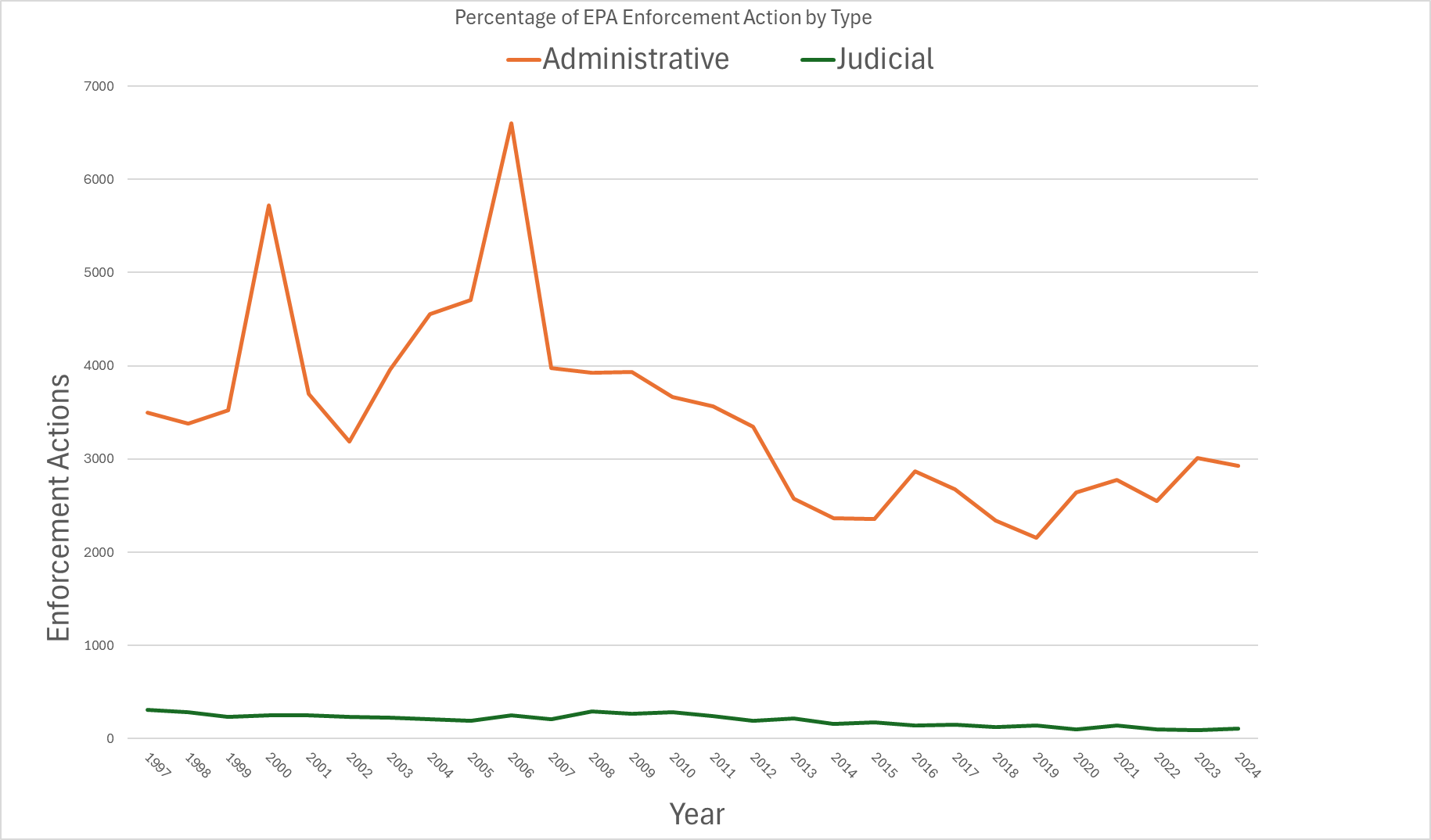
Figure 1. Percentage of EPA Enforcement Action by Type.[48]
If Jarkesy’s logic regarding the SEC is held to apply to the EPA, defendants will claim they have a jury trial right. Actions will then have to go through the Department of Justice, involving more expensive and time-consuming proceedings by attorneys from the Department of Justice.
In applying Jarkesy to the EPA, the first analysis is whether the civil penalties imposed are legal or equitable in nature. A major focus in the analysis of SEC penalties was whether they were designed to make victims of fraud whole or simply to punish wrongdoers.[49] As discussed above, the majority looked to a previous EPA case, Tull, to show that the remedy can be the decisive factor in whether the claim is legal or equitable.[50] Like the civil penalties imposed by the EPA in Tull, the $300,000 fine George Jarkesy received went to government coffers, not to victims.[51] Because the penalties imposed on fraudsters were designed to castigate and thus disincentivize fraud, the Court found the claim to be a legal one.[52] Like the SEC’s interest in keeping securities markets fair to the public, EPA regulations largely serve the people’s interest in an environment free of unnecessary despoilation. Given the remedy, the actions brought by the EPA are probably legal in nature, suggesting that they, too, will be subject to jury trials.
Next, the Court will need to evaluate if EPA enforcement falls into the public rights exception allowing agencies to forego a jury trial. They are likely to focus on whether any given enforcement action is analogous to a “suit at common law.”[53] The Roberts Court found that SEC securities fraud is close enough to the types of fraud penalized in 1700s England that it required a jury trial under the Constitution.[54] While there was no CWA, CAA, or RCRA 300 years ago, there were nuisance torts that sought to penalize environmental contamination affecting plaintiffs’ use and enjoyment of their land.[55] One of the earliest precursors to environmental law is Aldred's Case, (1610) 77 Eng. Rep. 816 (KB). Still cited in nuisance cases today, the matter involved a next-door neighbor’s pig sty.[56] In awarding damages to the plaintiff, the court relied on sic utere tuo ut alienum non laedas, an ancient doctrine that affirms that a property owner must use his land in such a way that does not harm the property of others.[57] While modern securities fraud differs from common law fraud in its complexity and method, it was close enough to invoke the protections of the Seventh Amendment.[58] Likewise, nuisance torts vindicating a complainant’s right to clean air, land, and water through the award of money damages will likely be seen as historical counterpart to the modern laws protecting the public’s right to the same.
Another reason to doubt that the public rights exception will rescue EPA enforcement is the majority’s naked uncertainty about when it applies. Declining to find a theme in instances where the public rights doctrine withdrew enforcement from the province of jury trials, the only certainty seemed to be Chief Justice John Roberts’s hesitancy to apply the exemption.[59]
If Jarkesy was a battle for authority between Atlas Roofing and Granfinanciera, considering how the two might apply to EPA actions is worthwhile. Atlas would seem to be the closer fit. As noted above, Atlas upheld OSHA penalties without requiring a jury trial. OSHA and the acts enforced by the EPA are both statutes passed by Congress and enforced by agencies. Granfinanciera took place within bankruptcy courts, a separate unit of the district court system established in the early 1800s.[60] While the Court went out of its way to state that Atlas was not overruled, the case’s logic did not carry the day, and it would be unwise for proponents of the ALJ system used by the EPA to rely on it.
The EPA relies heavily on ALJs in its enforcement actions.[61] The most probable outcome of Jarkesy is that those actions will now have to be tried in front of a jury. “Most EPA action proceeds via administrative actions,” explained Michael Vandenbergh, professor of environmental law at Vanderbilt University. “The agency could win in civil court, but they don't have the resources. The balance of power shifts dramatically because defendants know that.”[62]
When brought in federal court, EPA enforcement actions are prosecuted by the Environment and Natural Resources Division (ENRD) of the Department of Justice (DOJ) on behalf of the EPA.[63] Removing the option to try cases administratively will likely strain EPA enforcement resources. “It seems wildly unlikely to me that Congress will give those agencies and the Department of Justice the massive infusion of money and personnel that they’d need to try all these cases before a jury,” legal writer Mark Joseph Stern said in an interview. “If every single time you want to bring a civil penalty, you have to call DOJ and ask to borrow some lawyers for a few years, you’re just going to drop the action instead.”[64] The additional costs in time and treasure to bring cases could result in a “chilling effect” on the EPA’s ability and willingness to hold wrongdoers accountable for violations of environmental laws.[65]
The EPA may opt to resolve their cases through a negotiated consent decree (CD) in light of Jarkesy’s enforcement changes.[66] Consent decrees are legally binding agreements between the government and Potentially Responsible Parties (PRPs).[67] Yet even if future environmental enforcement occurs using CDs, “that is still an extraordinary amount of ‘new’ work for ENRD (at a minimum: negotiations, compliant drafting, CD drafting, approval memoranda, et cetera) for which ENRD is likely not currently funded,” according to Professor Patrick Jacobi of Denver University.[68] Even more concerning, Congress cannot pass a law allowing a return to ALJs, since this has been effectively banned by the Supreme Court[69]. The only way to sustain the current level of enforcement would be additional funding of ENRD.[70]
Given the current climate, additional funding for the Division seems improbable. Shortly after President Donald J. Trump took office to assume his second term, ENRD was ordered to halt all enforcement efforts.[71] “For the time being, it cannot file new complaints about companies that are breaking environmental laws, lodge or enter consent decrees to wind down such litigation, or move to intervene in other cases,” the New York Times reported in January of 2025.[72]
IV. Loper Bright and Corner Post: The Other Administrative Law Decisions
The much-discussed “Chevron decision” grabbed headlines last year for its threat to agency authority. Prior to the opinion, Loper Bright Enters. v. Raimondo, 603 U.S. 369 (2024), courts gave deference to administrative agencies applying regulations passed by the legislature under the doctrine of Chevron, U.S.A., Inc. v. Nat. Res. Def. Council, Inc., 467 U.S. 837 (1984). “The legislative branch writes the law,” explained Judge Lynn Alexander, professor of administrative law at Nashville School of Law. “The agencies pass rules and regulations to implement that law. The agency is charged with promulgating the rules and regulations to fill in the blanks of the legislation.”[73]
Agencies have always been limited in that their interpretations of laws had to be reasonable and could not explicitly conflict with language in statutes passed by Congress.[74] However, their interpretations carried weight when a dispute came before a court.[75] Now, courts are to use only conventional norms around statutory construction to interpret regulations. The agencies’ own views are relevant solely for their persuasive value.[76] The result is that some of the power formerly vested in the agencies like the EPA, a part of the administrative state under the executive branch of government, has now shifted to the judiciary.
Corner Post, Inc. v. Bd. of Governors of the Fed. Rsrv. Sys. 603 U.S. 799 (2024) has been described as a “sleeper”[77] case when it comes to agency doctrine and has generated comparatively little discussion and analysis. The issue in Corner Post was whether a company formed in 2018 could bring a facial challenge against a regulation put forth by the Board of Governors of the Federal Reserve more than six years after the rule went into effect.[78] The six-year statute of limitations, provided by 28 U.S.C. § 2401(a), began running when the cause of action “accrued.” Prior to the High Court’s decision, five Circuit Courts held that accrual begins at the time the regulation is promulgated, while one interpreted accrual as beginning at the time of injury.[79] The Court ruled that the injury, not the promulgation, starts the clock running.[80] Thus, statutes that have been in place for decades can now be facially challenged by newly incorporated LLCs.[81]
But combined with the Chevron decision and others, “the Corner Post case could do to New Deal regulations what Citizens United did to campaign finance.”[82] Indeed, Benjamin Snyder said during oral arguments that deciding in favor of the Corner Post truck stop and the retail groups “would magnify the effect of any other decisions changing the way this Court or other courts have approached administrative law questions, because it would…potentially mean that those changes would then be applied retroactively to every regulation that an agency has adopted in the last…75 years or so.”[83] In expanding the time to challenge a regulation, the Corner Post ruling “will make challenges to enforcement easier no matter the nature of the challenge, and it will make it nearly impossible for EPA to win any statute of limitation argument against these challenges,” Professor Jacobi agreed.[84]
A further downstream impact of Corner Post is that challengers could have even greater victories against the EPA. If the EPA lost on a challenge to a regulation as it applied to a PRP, the rule would generally be invalidated only as to the enforcee. However, when the EPA loses on a “facial challenge,” it risks the court granting a nationwide injunction against the entire regulation.[85] Thus, bringing each case against a PRP carries a much greater risk of endangering agency legitimacy.
V. Conclusion
The 2024 Supreme Court docket has been called “the administrative law term,” by some commentators.[86] While Loper Bright and Corner Post will also have an impact, Jarkesy is the most likely of the administrative law decisions to change the game for the EPA by requiring a modification in how about ninety percent of all penalties are enforced. The securities fraud punished in Jarkesy can be seen as analogous to pollution. Just as coal ash, mercury, and other toxins pollute our air and water, fraud contaminates financial markets, undermining consumers’ financial well-being. Jarkesy took away an important tool the SEC had to preserve the integrity of investment markets—administrative civil penalties. Expanding its reasoning to other agencies, it is almost certain to remove that tool from the EPA’s toolbox as well. In her Jarkesy dissent, Justice Sotomayor quoted George Washington’s caution against factional power grabs in his farewell address. But the address had a further admonition—“for the efficient management of your common interests in a country so extensive as ours, a government of as much vigor as is consistent with the perfect security of liberty is indispensable.”[87] The “administrative law term” leaves the government less vigorous in its defense of the liberty of a clean and safe environment.
NOTES
[1] Initial Decision in In re John Thomas Capital Management Group, LLC, Admin Proc. File No. 3-15255 at 15 (SEC, Oct. 17, 2014).
[2] Id at 13.
[3] Brief for Respondent, Jarkesy v. SEC, 2021 U.S. 5th Cir. Briefs LEXIS 278 (No. 20-61007).
[4] Id.
[5] EPA, https://www.epa.gov/history/origins-epa (last visited Apr. 7, 2025).
[6] EPA, https://www.epa.gov/aboutepa/our-mission-and-what-we-do (last visited Apr. 7, 2025).
[7] SEC v. Jarkesy, 603 U.S. 109 at 16 (2024).
[8] Id at 18.
[9] U.S. Const. amend. VII.
[10] Note 7 at 92.
[11] Dahlia Lithwick & Mark Joseph Stern, Sonia Sotomayor Is Trying to Warn Us About the Supreme Court’s Dirtiest Open Secret, Slate (Jun. 27, 2024) https://slate.com/news-and-politics/2024/06/sonia-sotomayor-warns-supreme-court-dirty-secret.html.
[12] 5-4: Securities and Exchange Commision v. Jarkesy, Prologue Projects (Sep. 17, 2024) (downloaded using Spotify).
[13] Note 7 at 131.
[14] Id at 46.
[15] 17 C.F.R. § 201.235(a)(5).
[16] Note 7 at 21.
[17] Tr. of Oral Arg. 24, SEC v. Jarkesy, 603 U.S. 109 (2024).
[18] Note 7 at 23.
[19] Id at 27.
[20] Id.
[21] N. Pipeline Constr. Co. v. Marathon Pipe Line Co., 458 U.S. 50 at 69 (1982).
[22] Note 7 at 25.
[23] Securities and Exchange Commision v. Jarkesy note 12.
[24] Den Ex Dem. Murray v. Hoboken Land & Improv. Co., 59 U.S. (18 How.) 272 (1855).
[25] Oceanic Steam Navigation Co. v. Stranahan, 214 U.S. 320, 29 S. Ct. 671 (1909).
[26] Ex parte Bakelite Corp., 279 U.S. 438, 49 S. Ct. 411 (1929).
[27] Note 7 at 32.
[28] Id at 33.
[29] Id at 91.
[30] Id at 36.
[31] Granfinanciera v. Nordberg, 492 U.S. 33 at 9 (1989).
[32] Id at 80.
[33] Note 7 at 34.
[34] Id.
[35] Id at 35.
[36] Id.
[37] Atlas Roofing v. OSHRC, 430 U.S. 442 (1977).
[38] Id.
[39] Id at 10.
[40] Id at 11.
[41] Note 7 at 39.
[42] Tull v. United States, 481 U.S. 412 at 7 (1987).
[43] Id at 8.
[44] Note 7 at 110.
[45] Jesse Eisinger, The Chickenshit Club: Why the Justice Department Fails to Prosecute Executives xvii (2017).
[46] E-mail from Patrick Jacobi, Denver Univ., to the author (Mar. 21, 2025, 12:13 CST) (on file with author).
[47] EPA, ECHO EPA Enforcement and Compliance Monitoring Data Download, https://echo.epa.gov/tools/data-downloads#downloads (Last visited March 19, 2025).
[48] Id.
[49] Note 7 at 23.
[50] Id at 110.
[51] Id at 24.
[52] Id.
[53] Id at 35.
[54] Id.
[55] Garrison v. New Fashion Pork LLP, 977 N.W.2d 67 (Iowa 2022).
[56] Id.
[57] Id.
[59] Note 7 at 33.
[60] The Evolution of US Bankruptcy Law: a time line, Federal Judicial Center, https://www.rib.uscourts.gov/newhome/docs/the_evelution_of_bankruptcy_law.pdf (last visited April 3, 2025).
[61] Jacobi, supra note 46.
[62] Telephone Interview with Michael Vandenbergh, Vand. Univ. (Mar. 17, 2025).
[63] Basic Information on Enforcement, EPA, https://www.epa.gov/enforcement/basic-information-enforcement, (last visited March 23, 2025).
[64] Note 11.
[65] Id.
[66] Jacobi, supra note 46.
[67] EPA, https://sor.epa.gov/sor_internet/registry/termreg/searchandretrieve/glossariesandkeywordlists/search.do?details=&vocabName=RCRA%20Glossary%20of%20Terms (last visited Apr. 10, 2025).
[68] Jacobi, supra note 46.
[69] Id.
[70] Id.
[71] Devlin Barret et. al., Trump Administration Moves Swiftly to Shake Up Top Career Justice Dept. Ranks, N.Y. Times (Jan. 27, 2025) https://www.nytimes.com/2025/01/27/us/trump-justice-department-career-ranks.html.
[72] Id.
[73] Telephone Interview with Lynn Alexander, (Mar. 14, 2025).
[74] Chevron, U.S.A., Inc. v. Nat. Res. Def. Council, Inc., 467 U.S. 837 (1984).
[75] Id.
[76] Shay Dvoretzky et al, Rolling Back the Administrative State: Understanding Trump’s Deregulatory Initiative, Skadden Publ’n / Exec. Briefing: Latest Updates on the Trump Admin. https://www.skadden.com/insights/publications/2025/02/rolling-back-the-administrative-state (Feb. 25, 2025).
[77] Lydia Wheeler, Truck Stop 'Sleeper Case' Could Open Old Rules to New Lawsuits, Bloomberg Law (Feb. 19, 2024).
[78] Corner Post, Inc. v. Bd. of Governors of the Fed. Rsrv. Sys. 603 U.S. 799 (2024).
[79] Id.
[80] Id.
[81] Id.
[82] Charles Pierce, The Corner Post Case Could Do to New Deal Regulations What Citizens United Did to Campaign Finance, Esquire, (Feb. 20, 2024) https://www.esquire.com/news-politics/politics/a46872722/supreme-court-corner-post-suit.
[83] Tr. of Oral Arg. 51, Corner Post, Inc. v. Bd. of Governors of the Fed. Rsrv. Sys., 603 U.S. 799, 144 S. Ct. 2440 (2024).
[84] See supra note 46.
[85] Id.
[86] Advisory Opinions: Is ‘Text, History, and Tradition’ Alive and Well?, The Dispatch (Jul. 9, 2004) (downloaded using Spotify).
[87] S. Pub. 115-5, U.S. Sen. Historical Off., Washington’s Farewell Address to the People of the United States at 13, https://www.senate.gov/artandhistory/history/resources/pdf/Washingtons_Farewell_Address.pdf.